


Many founders begin with a technology.
They develop an application, an artificial intelligence tool, a marketplace, a device or a digital platform. They then ask how they can sell the technology and recover what they invested in building it.
This appears logical, but it starts commercialization from the wrong place. Technology may make a business possible, but technology is not necessarily the business. A technically impressive product can attract users without generating meaningful revenue. It can solve a real problem without creating a sustainable transaction.
The more important question is not simply, “How can we make money from this technology?” It is:
What commerce can this technology enable, and how can the startup participate in the value created through that commerce?
Airbnb does not primarily make money by selling software. It makes money when accommodation is discovered, booked and paid for through the commercial system enabled by its technology. Uber does not primarily make money by selling its application. It makes money when transportation capacity is matched with passenger demand and converted into completed rides.
Apple earns substantial revenue from technological products, but its opportunity extends beyond device sales. Its technology also creates an ecosystem in which developers build applications, users discover digital services, payments are processed and commercial relationships develop.
Technology enables the system. Commerce creates the revenue.
The Startup Node Commerce Framework provides a method for designing such a system.
From selling a product to organising a market
A conventional product business creates something and sells it to a customer. This remains a valid business model. A company can manufacture a device, license software or sell access to a digital service. However, this represents only one way of creating and capturing value.
Some technology companies go further. Instead of selling only what they create, they build systems that help other commercial actors produce, present and exchange value. They organise markets.
Airbnb organises interactions among hosts, travellers and property-service providers. Uber organises drivers, passengers and services supporting transportation. Apple organises developers, applications, device users and development infrastructure. DoorDash organises restaurants, consumers, delivery capacity and restaurant-support services.
These companies create environments in which multiple participants perform commercial activities that would be more difficult, fragmented or expensive outside the system.
The startup cannot create this position merely by declaring itself a platform. It must identify an important market participant, solve a core problem for that participant, bring the participant's inventory into a commercial environment, aggregate demand and coordinate the productive resources required to sustain that inventory.
This important participant is the Startup Node.
The Startup Node
The Startup Node is the independent market participant that brings or creates the inventory, productive capacity, service capability, content or market access around which the startup organises commerce.
The Startup Node is not the startup operating the system.
For Airbnb, Airbnb is the framework operator and hosts are the Startup Nodes. They bring rooms, apartments and houses into the system. For Uber, drivers are the Startup Nodes. They bring vehicles, time and transportation capacity. For Apple's App Store, application developers are the Startup Nodes. They bring applications, games and digital services. For DoorDash, restaurants are the Startup Nodes. They bring menus, kitchens and prepared-food inventory.
A strong Startup Node usually has four characteristics:
- It already participates in a real market.
- It possesses or can create commercially valuable inventory.
- Its members share a recurring commercial or operational problem.
- Once aggregated, its members become attractive to customers, suppliers and partners.
The startup's first challenge is to determine who this actor should be. The second is to understand why that participant should join its system.
Build a commercial house for the node
Startup Nodes do not join because the technology is impressive. They join because the system solves an important problem.
An Airbnb host may need visibility, bookings, payment collection, reputation and trust. An application developer may need a credible environment in which applications can be published and discovered. A restaurant may need a digital presence through which customers can view menus and place orders.
The startup must therefore build a commercial house for the node and its inventory. The framework calls this the Node Enablement Product.
The Node Enablement Product is the commercial environment through which Startup Nodes establish a presence and make their inventory organised, visible, discoverable and commercially accessible.
For Airbnb, the host platform and property-listing environment constitute the commercial house. For Apple, the App Store publishing environment gives developers a commercial presence. For DoorDash, the merchant environment gives restaurants a place to present their menus.
Constructing the house does not guarantee commerce. The startup must also bring customers into it.
Aggregate demand around the inventory
A marketplace containing inventory but no customers has little value for its Startup Nodes.
The Demand Aggregation Product attracts and concentrates the customers who will discover, adopt or purchase the inventory provided by Startup Nodes.
Airbnb gives travellers a convenient way to discover and book accommodation. Uber gives passengers a way to request transportation. DoorDash gives consumers a way to discover restaurants and order food. YouTube gives viewers access to organised video content.
Apple's case is instructive. The iPhone and wider device ecosystem aggregate a large population of engaged users. This installed base makes the ecosystem commercially attractive to developers. The iPhone is therefore both a profitable technology product and a Demand Aggregation Product.
The Node Enablement Product gives inventory a commercial home. The Demand Aggregation Product brings customers to that home.
Help the node create and deliver inventory
The Startup Node also has an upstream side.
Hosts need cleaning, insurance, maintenance and property-management services. Drivers need vehicles, fuel, insurance, financing and repairs. Developers need development tools, testing infrastructure, APIs, cloud services and hosting. Restaurants need ingredients, packaging, equipment and logistics.
When a startup aggregates a significant number of nodes, those nodes become a valuable market for suppliers. The startup can organise this upstream market through the Trade Orchestration Product.
The Trade Orchestration Product connects Startup Nodes to the suppliers, services, infrastructure and productive resources required to create and deliver their inventory.
For Uber, this may include vehicle financing, insurance, maintenance and fuel services. For Airbnb, it may include cleaners, photographers, property managers and insurance. For Apple, it includes development tools, SDKs, APIs, testing systems and cloud infrastructure.
Trade Orchestration helps the node produce. Node Enablement helps the node sell.
The three-product architecture
The framework therefore contains three connected product systems:
- The Node Enablement Product provides the commercial house in which the Startup Node and its inventory participate in the market.
- The Demand Aggregation Product attracts customers and converts demand into transactions involving node inventory.
- The Trade Orchestration Product connects the node to the suppliers and productive resources required to create and deliver inventory.
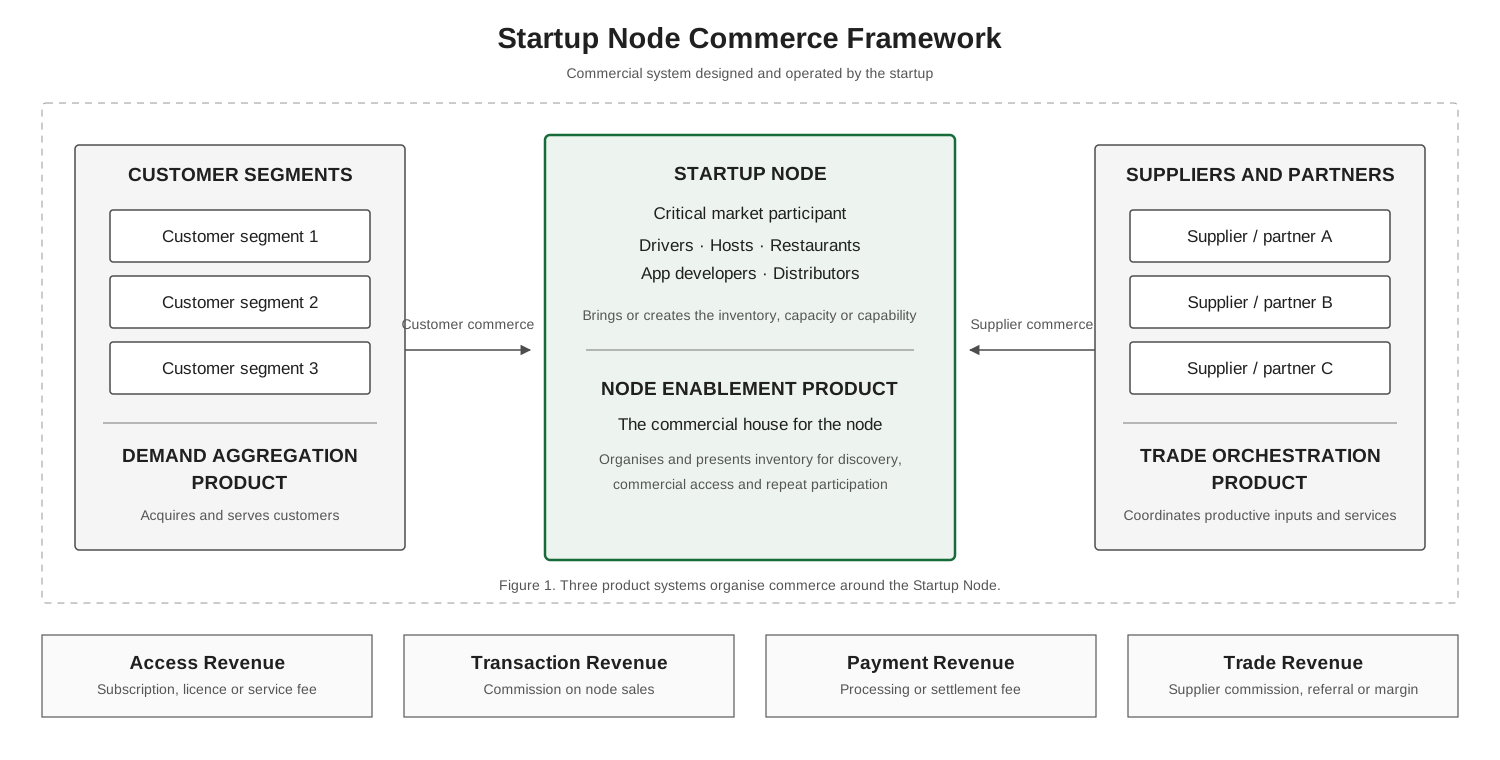
The startup designs and operates the complete architecture. The Startup Node sits at the centre because its inventory connects the upstream supply ecosystem with downstream customer demand. But the node does not own the framework.
Creating a commercial centre of gravity
A commercial centre of gravity is created when market participants increasingly organise their activities around the startup's system.
Startup Nodes use it to establish commercial identities, present inventory and reach customers. Customers use it to discover, evaluate and purchase inventory. Suppliers use it to reach an aggregated population of nodes. Payments and transactions move through it. Information generated by these activities improves coordination and trust.
The Startup Node is the central market participant. The commercial centre of gravity is the complete system through which nodes, inventory, customers, suppliers, transactions and payments converge.
The centre of gravity is not a single product. It emerges from successfully integrating the three product systems and creating repeated, economically meaningful commerce.
Four layers of revenue
Once commerce flows through the system, the startup can capture value through four revenue layers: Access Revenue, Transaction Revenue, Payment Revenue and Trade Revenue.
Access Revenue
Access Revenue is generated when a participant pays to enter, use or obtain enhanced capabilities within the system. It can include subscription fees, licences, memberships, listings, professional accounts and service fees.
This is the layer most commonly associated with selling technology. There is nothing inherently weak about it. The limitation appears when a startup assumes software access represents the complete commercial opportunity.
Selling access to technology is one revenue layer—not necessarily the entire business model.
Transaction Revenue
Transaction Revenue is generated when customers purchase, book or consume inventory provided by Startup Nodes. It includes Airbnb commissions on bookings, Uber commissions on rides, Apple commissions on application purchases and DoorDash commissions on restaurant orders.
Access Revenue monetises participation in the system. Transaction Revenue monetises commercial activity within it.
Payment Revenue
Payment Revenue is generated from moving, collecting, settling, protecting or financing money within the system. It can include processing fees, collection fees, settlement fees, foreign-exchange margins, credit services and merchant financial services.
When a startup facilitates repeated transactions, it gains a strategic position in the flow of money and can become part of the financial infrastructure of that commerce.
Trade Revenue
Trade Revenue is generated from upstream commerce between Startup Nodes and the suppliers or partners that help them create and deliver inventory. It may include supplier commissions, procurement margins, logistics, insurance, financing, hosting, maintenance, packaging and compliance services.
The startup earns not only when the node sells inventory, but also when the node obtains what it needs to produce that inventory.
Technology companies can earn from all four layers
A company may begin with one revenue layer. It may initially charge for access to useful software. As demand grows, it may earn commissions from transactions. Once payments flow through the system, it may offer financial services. As nodes become aggregated, it may organise upstream suppliers and capture Trade Revenue.
This can be expressed as:
Access → Transactions → Payments → Trade
The sequence is not compulsory. Some startups remove access fees to recruit nodes quickly and monetise transactions. Others begin with a paid node service before sufficient demand exists. The purpose is not to force every startup to activate every layer. It is to prevent founders from assuming the first visible way of making money is the only available way.
Designing with the framework
A founder applying the framework should begin with the existing market, not a list of software features.
- Identify where customers, suppliers, inventory and payments already exist.
- Select the participant who brings or creates the inventory.
- Diagnose the node's most urgent commercial problem.
- Build the commercial house in which the node and its inventory will participate.
- Design a product that aggregates customer demand.
- Coordinate the upstream resources required by the node.
- Identify opportunities for Access, Transaction, Payment and Trade Revenue.
- Test the system through active nodes, inventory, customers, transactions, retention and revenue.
The central lesson
The most valuable technology businesses do more than sell technological products. They create commercial systems.
They identify independent actors who bring inventory or productive capacity. They give that inventory a commercial house. They aggregate customers around it. They coordinate the suppliers and services required to sustain it. They facilitate transactions and payments.
As participation grows, commerce increasingly converges within the system. The startup becomes a commercial centre of gravity.
Technology may attract, enable and coordinate participants. But commerce produces the scalable revenue.
Do not build technology and then search for a business model. Design the commercial system first—and build the technology required to make it work.
Scino360 partners with universities, research groups, innovation hubs, and funding organizations to transform scientific knowledge into commercially viable ventures through a proprietary mathematical approach to business model innovation.
Discuss a partnership